
 Written by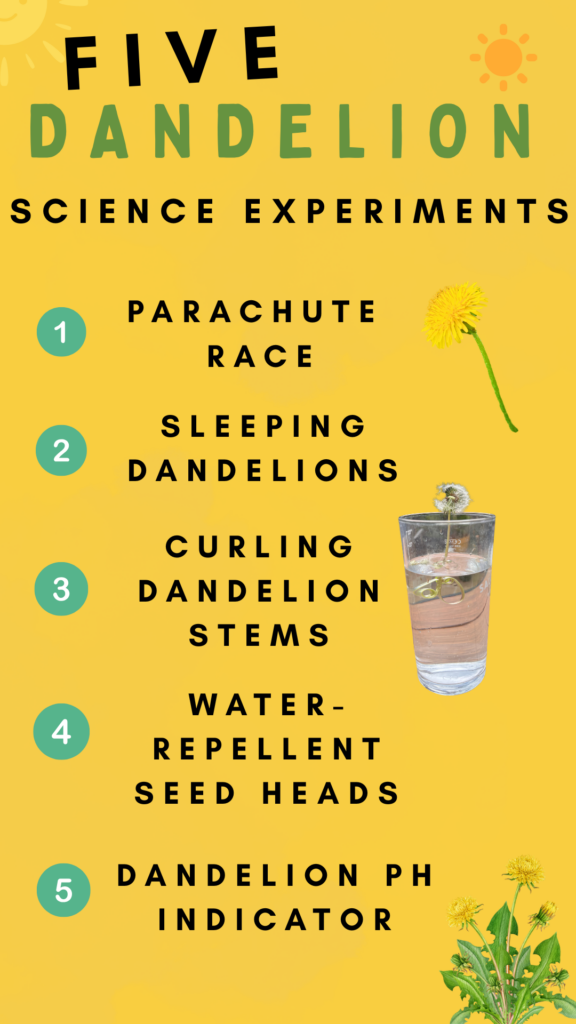
Dandelions are so much more than an annoying weed. They can track the sun, turn into the puffballs we love to blow around, and survive year after year, all while providing a food source for pollinating insects. They are perfect for a spring science challenge as they are free and easily accessible.
My five dandelion science experiments are great for exploring these understated garden heroes.
Five Dandelion Science Experiments
Parachute Race
A dandelion parachute creates a ring shaped air bubble ( vortex ring ) that hovers above the seeds as they fall, pulling them upward. This helps them catch the wind and travel further away from the parent plant.
The Experiment
Drop a dandelion seed and a small square of paper from the same height and watch to see which hits the ground first.
Sleeping Dandelions
Did you know dandelions close up at night to keep their pollen safe from non-pollinating insects and water?
The Experiment
Look for a dandelion that’s fully open around lunchtime. Cover it with a dark box. Check again in about two hours? You should find it has closed up! This process is called nyctinasty.
Curling Dandelion Stems
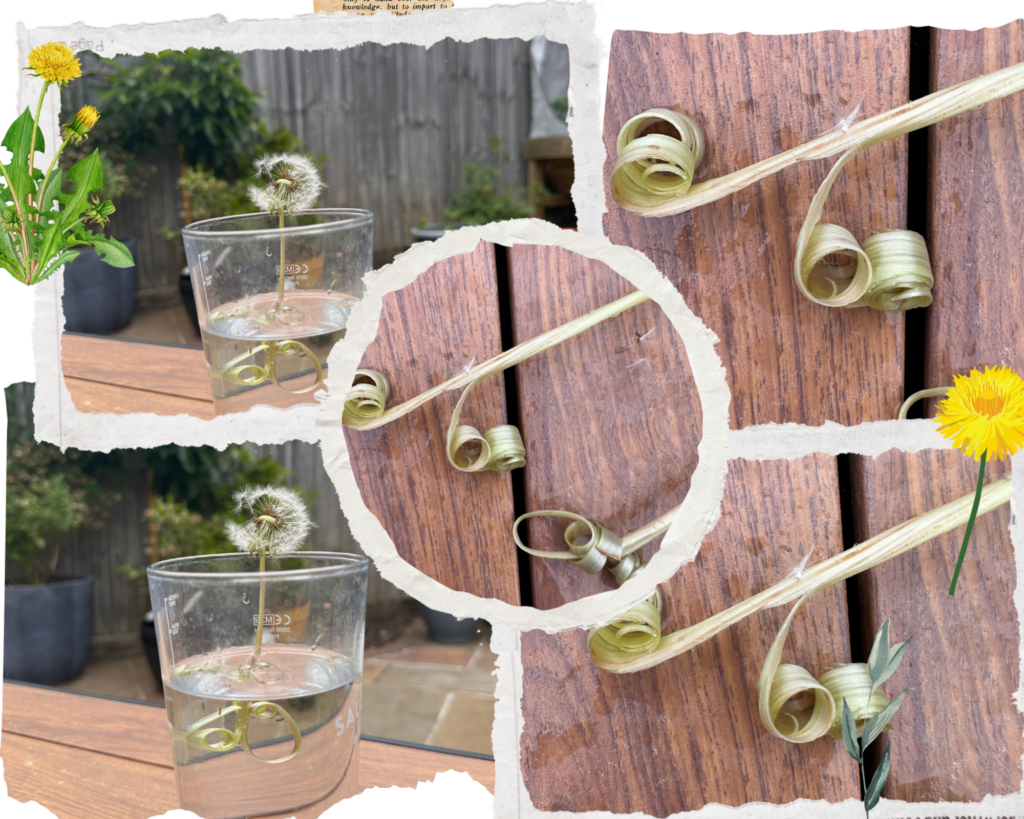
If you split a dandelion stem in half and place it in water, the stem curls into tight ringlets within a couple of minutes. This is because the inside of a dandelion stem contains thin-walled parenchyma cells, which absorb water and expand quickly.
The outside of the stem is thick and waxy, it can’t easily expand and doesn’t absorb water.
As the inner cells stretch and swell, the outside of the stem is forced to curve, resulting in tight curls.
The Experiment
Take a fresh dandelion and carefully cut the stem in half.
Place the dandelion in water and watch as the two parts of the stem curl upwards.
Water-repellent Seed Heads
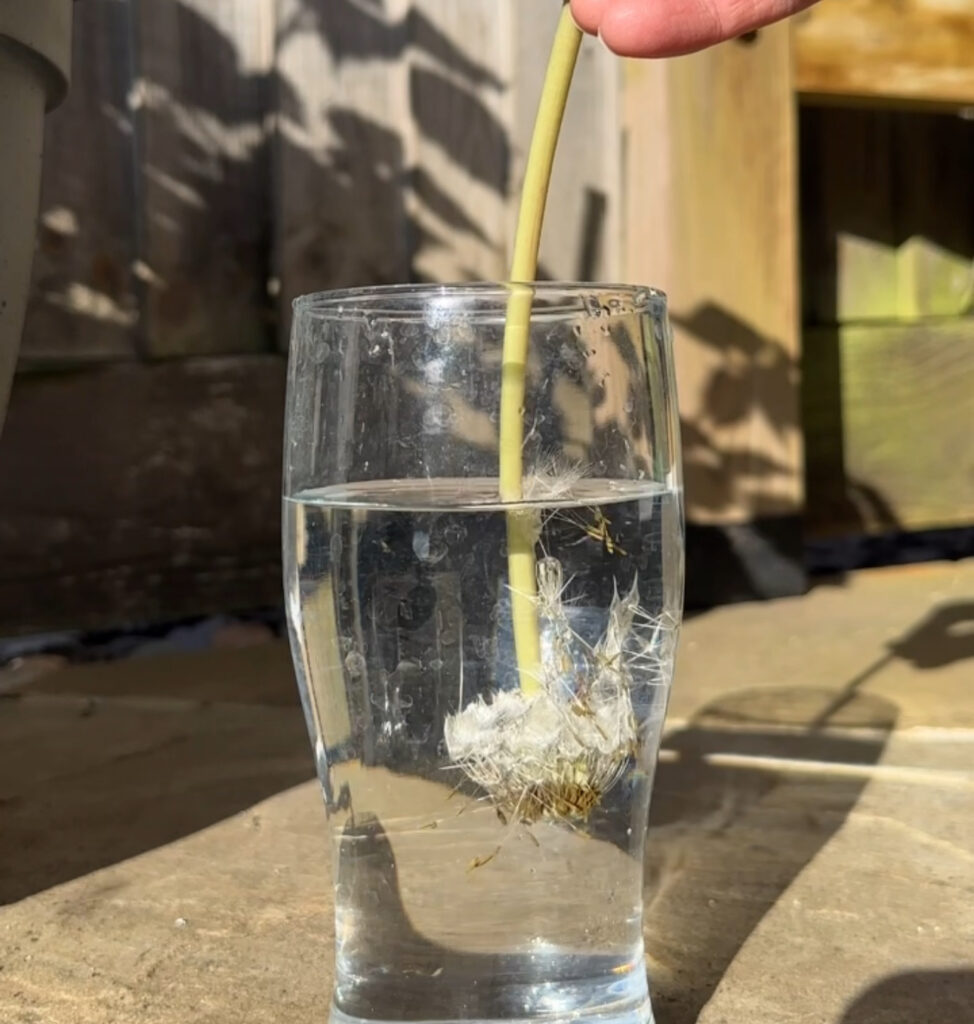
Dandelion seed heads have an impressive water-repelling feature that keeps the seeds safe in the rain. You can easily demonstrate this by placing the seed head in a glass of water and pulling it back out.
When you pull the seed head out, it looks as dry as before it was dunked!
Dandelion Seed Head Demonstration
Dandelion pH Indicator
If you’ve ever made a pH indicator with red cabbage, you’ll know how effective natural pH indicators can be. Dandelions can also be used as a pH Indicator, but you don’t see the dramatic change red cabbage gives.
The Experiment
Pick about 5 fresh dandelions. Remove the petals and place them into a pan of water until the liquid turns yellow.
Leave the liquid to cool. This is your indicator.
Pour a small amount of the liquid into 2 small beakers or test tubes. Add a little white vinegar to one, and baking soda water (a little baking soda mixed with water until it dissolves) to the other, and observe the changes in colour.
More spring science for kids
Learn about germination with a bean in a jar demonstration.
Try one of my 5 daffodil science experiments.
Set up a fun seed race with winners for the tallest flower, the thickest stem, and the first to germinate.
Last Updated on May 15, 2026 by Emma Vanstone
The post Dandelion Science Experiments appeared first on Science Experiments for Kids.
Science Experiments for Kids Read More